
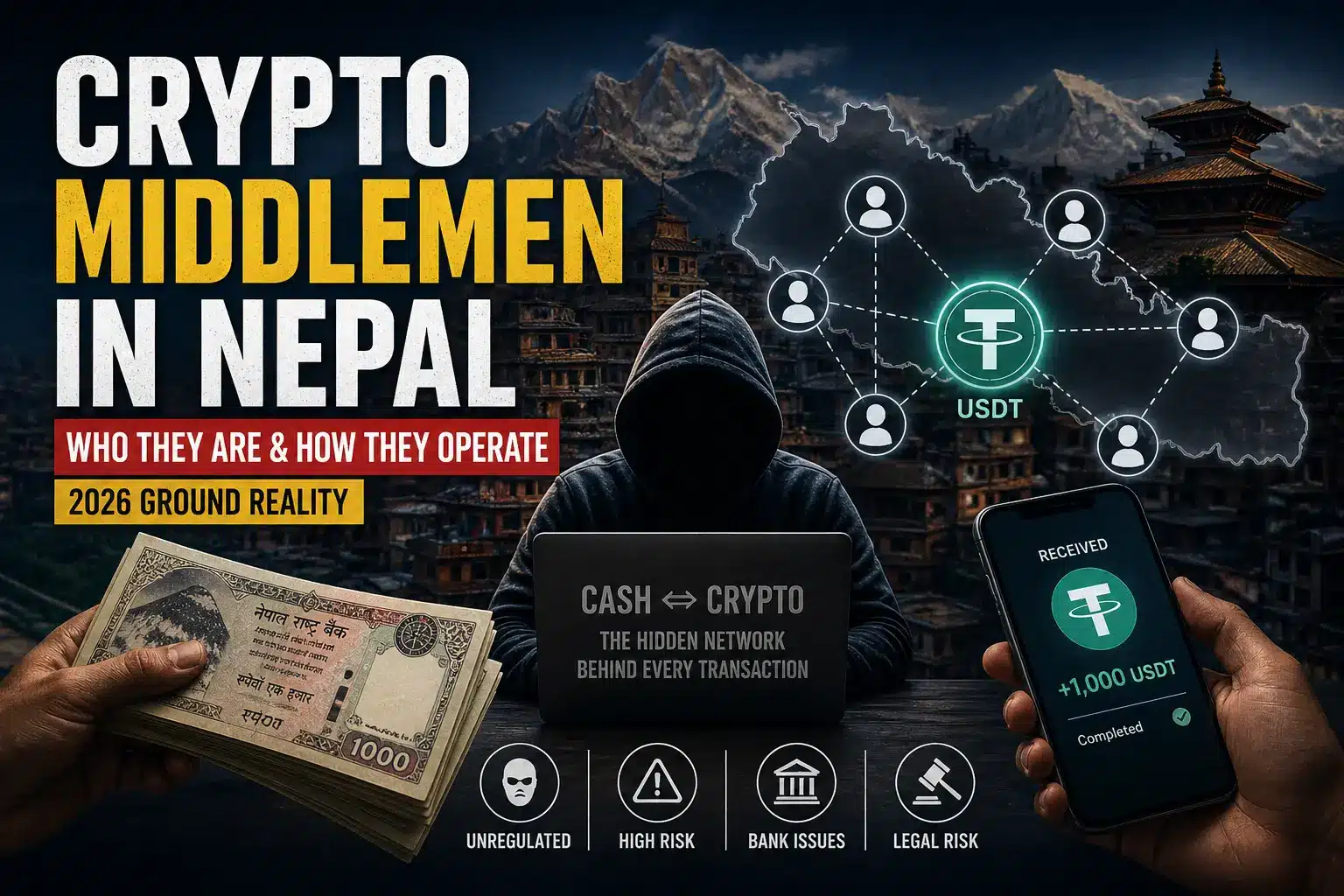
Crypto Middlemen in Nepal doesn’t work the way people imagine it does.
If you’ve ever watched YouTube videos or read international blogs, you’ll see a clean system: create an account, link your bank, buy crypto, and you’re done. Everything looks structured, safe, and almost boring in its simplicity.
But the moment you try to apply that same process in Nepal, everything breaks.
There is no official exchange you can legally use. There is no direct way to connect your bank account to crypto. And more importantly, there is no legal protection if anything goes wrong. Because of this gap, a completely different system has quietly taken over — one that doesn’t rely on platforms, but on people.
That’s where crypto middlemen come in.
The Invisible Layer Behind Crypto in Nepal
Most people who are new to crypto in Nepal think they are dealing directly with the market. They believe they are buying USDT, trading coins, or sending funds just like users in other countries. But if you look closely, almost every transaction passes through another person.
That person is not just helping — they are replacing the entire system.
Crypto middlemen exist because Nepal doesn’t allow the normal flow of crypto. The traditional structure of bank → exchange → wallet simply doesn’t function here. Banks monitor unusual activity, foreign exchange laws are strict, and anything linked to cryptocurrency is treated as suspicious or illegal.
So instead of interacting with platforms, people interact with individuals who already have access to crypto. These individuals become the bridge between Nepali rupees and digital assets. Without them, most users wouldn’t even be able to enter the crypto space.
Who These Middlemen Actually Are
The word “middleman” might make it sound like a formal role, but in Nepal, it’s far from that.
These are not registered businesses or licensed brokers. They are regular people — students, freelancers, traders, or even someone you were introduced to by a friend. Some of them started small, just helping a few people convert money into USDT. Over time, they built connections, gained trust, and slowly turned into go-to contacts for dozens or even hundreds of users.
What makes them powerful is not just their access to crypto, but their network.
A middleman usually knows:
- Who is buying
- Who is selling
- Who needs quick cash
- Who wants to hold long-term
They are constantly connecting these dots behind the scenes. In a way, they function like a mini exchange — but instead of algorithms, everything runs on human coordination.
How a Typical Crypto Transaction Really Happens
To understand how deeply middlemen are involved, you have to look at what a normal transaction actually looks like in Nepal.
Let’s say someone wants to buy USDT.
They don’t open an exchange and click “buy.” Instead, they message a middleman, usually on Telegram or WhatsApp. The conversation is simple, almost casual. The buyer asks for the current rate, and the middleman responds with a slightly higher price than the global market. That difference is where their profit lies.
Once the rate is agreed upon, the next step is sending money. This is where things become sensitive. The buyer transfers Nepali rupees through a bank account or sometimes through digital wallets like eSewa or Khalti, often indirectly to avoid obvious patterns.
After confirming the payment, the middleman sends USDT to the buyer’s wallet, usually through a low-fee network like TRC20. The entire process might take just a few minutes if everything goes smoothly.
When the user wants to convert crypto back into cash, the process simply runs in reverse.
It sounds simple on the surface, but what makes it complex is everything happening underneath — the risk, the trust, and the constant need to stay unnoticed.
Why People Still Trust Middlemen
From an outside perspective, relying on a random individual for financial transactions sounds like a terrible idea. There is no contract, no guarantee, and no safety net. Yet, thousands of Nepali users continue to depend on this system every day.
The reason is not ignorance — it’s necessity.
People don’t trust middlemen because they are safe. They trust them because there is no alternative.
Over time, trust is built through repeated small transactions. A user might start with a small amount, test the process, and then gradually increase their volume as confidence grows. In many cases, relationships form. Middlemen become familiar names, not just contacts on a screen.
This is why crypto in Nepal feels less like a financial system and more like a network of personal connections.
The Risk That Never Goes Away
Even with trust, the risk never disappears. It just becomes easier to ignore.
One of the biggest risks is the complete lack of legal protection. If a middleman disappears after receiving money, there is very little the victim can do. Reporting the issue to authorities often leads nowhere, because the transaction itself involves an illegal activity.
Another major risk comes from banking systems. Nepali banks have become increasingly strict about monitoring unusual transaction patterns. Repeated transfers, especially between unknown accounts, can trigger red flags. This is exactly what leads to account freezes, something you’ve already explored in “How Nepali Bank Accounts Get Frozen Due to Crypto (2026 Real Cases Explained)”.
There’s also the growing problem of scams. Many users are lured into fake deals through Telegram groups, where impersonation and manipulation are common. This connects directly with your post “How Telegram Crypto Groups Scam Nepali Users (2026 Exposed Guide)”, where the same patterns appear again and again.
So while middlemen enable the system, they also introduce its biggest vulnerabilities.
The Hidden Structure Behind the Scenes
What most people don’t realize is that middlemen rarely operate alone.
Behind a single transaction, there is often a chain of connections. A middleman receiving your payment might be sourcing USDT from another trader, who in turn is connected to a larger network. Money moves through multiple layers, sometimes across different accounts and identities.
This layered structure helps them stay under the radar, but it also makes the system harder to track and understand. It’s not just one person managing everything — it’s a network that constantly shifts and adapts.
This is also why crypto activity in Nepal hasn’t disappeared despite strict regulations. It has simply become more decentralized, more private, and more dependent on human networks.
Legal Reality: The Part Most People Ignore
No matter how normal this system may feel to users, the legal situation hasn’t changed.
Cryptocurrency activities in Nepal remain illegal. This includes not just trading, but also facilitating transactions — which directly applies to middlemen. The risks are not theoretical. There have been cases where individuals faced investigations, account seizures, and even legal action for involvement in crypto-related activities.
This is something many users choose to ignore, especially when transactions are small or infrequent. But the reality is that the system operates in a legal grey zone where consequences can appear suddenly and without warning.
Comparison: Middlemen vs Official Systems
| Aspect | Middlemen in Nepal | Official Crypto Systems |
|---|---|---|
| Structure | Informal, person-based | Platform-based |
| Safety | Depends on trust | System-regulated |
| Transparency | Low | High |
| Legal Status | Illegal | Legal in many countries |
| Risk Level | High | Moderate |
This difference explains everything. Nepal’s crypto system is not just a variation — it’s an entirely different model built out of necessity.
The Human Side of the System
At its core, crypto in Nepal is not about technology. It’s about people.
It’s about the freelancer who receives payment in USDT because traditional methods are too slow or expensive. It’s about the student trying to earn online and convert small amounts into cash. It’s about traders who have built entire routines around buying and selling through trusted contacts.
Middlemen sit in the middle of all these stories.
They are not always villains or heroes. Some are genuinely helping others access opportunities that would otherwise be impossible. Others are simply taking advantage of a system that has no rules.
But either way, they are essential.
Where This System Is Headed
Looking ahead, it’s hard to imagine this system staying exactly the same.
On one hand, enforcement could become stricter. Banks might improve their monitoring systems, and authorities could take stronger action against large-scale operators. This would make the role of middlemen more risky and less sustainable.
On the other hand, the system could evolve further underground. Smaller, more private networks may replace public groups, making transactions even harder to detect.
There is also the long-term possibility of regulation. If Nepal ever decides to introduce controlled crypto policies or a central bank digital currency, the role of middlemen could either shrink or transform into something more formal.
Until then, the system remains what it is today — unofficial, unstable, but surprisingly active.
Final Thoughts
Crypto middlemen in Nepal are not just a small part of the system.
They are the system.
Without them, most crypto activity would come to a halt. They fill the gaps left by regulation, infrastructure, and access. But at the same time, they carry all the risks that come with operating in an unregulated environment.
That’s the reality most people don’t fully understand.
Crypto in Nepal is not just about buying and selling digital assets. It’s about navigating a network of trust, risk, and uncertainty — where every transaction depends on someone in the middle.