
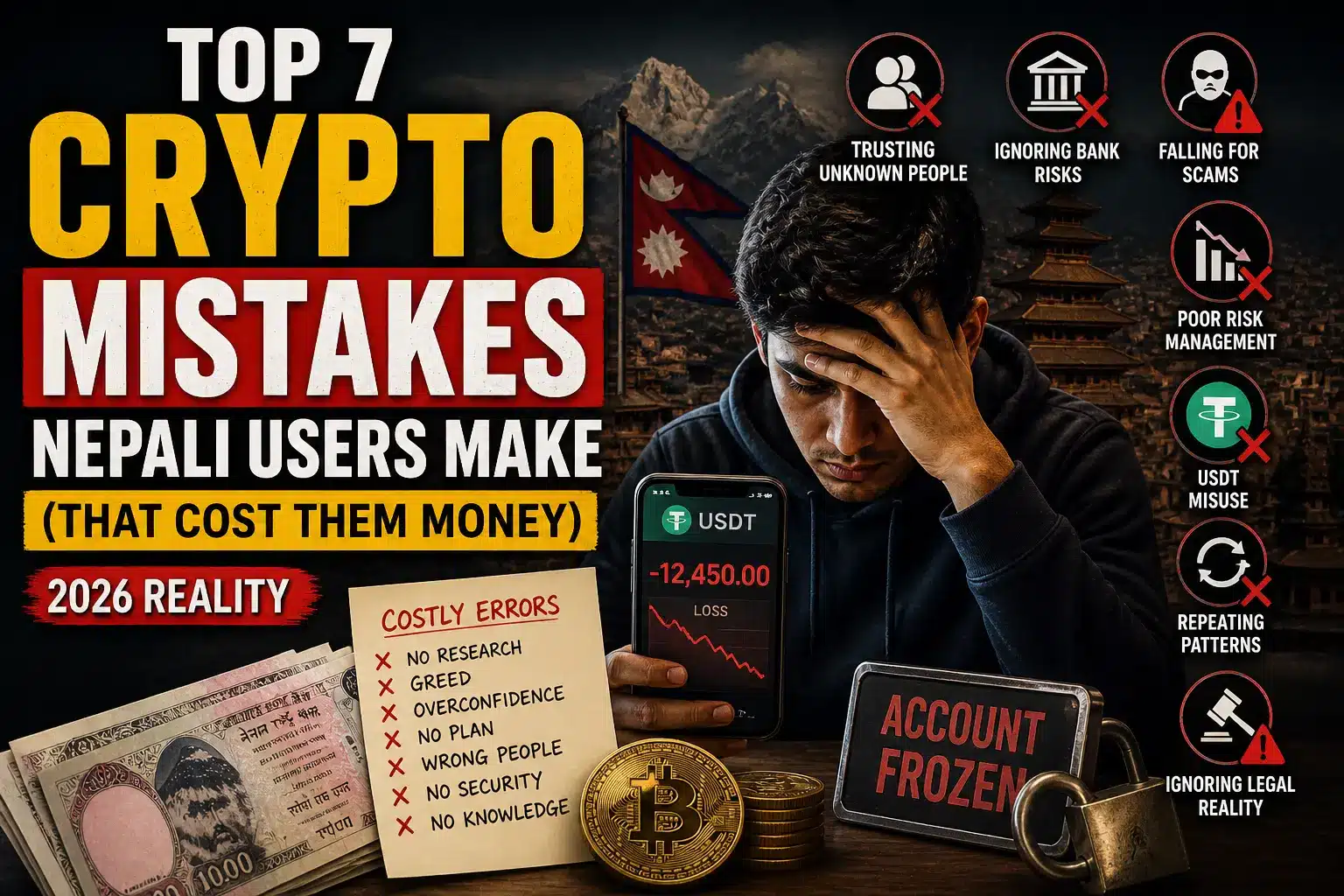
Crypto in Nepal isn’t just risky—it’s misunderstood.
If you scroll through social media, watch YouTube, or talk to people around you, crypto is often presented as something simple. Buy low, sell high, make profit. That’s the narrative. Clean, attractive, and dangerously incomplete.
Because in Nepal, crypto doesn’t operate inside a normal system.
There are no official exchanges you can legally rely on. There is no direct bank integration. There is no safety net when things go wrong. What exists instead is a mix of informal systems, human networks, and silent risks that most users only realize after they’ve already lost money.
That’s why the biggest losses in Nepal don’t come from market crashes. They come from mistakes—repeated, predictable, and deeply rooted in how people use crypto here.
These are not theoretical mistakes. These are patterns you can observe across students, freelancers, traders, and even experienced users. The same habits, the same assumptions, and eventually, the same outcomes.
Mistake 1: Building Trust in People Instead of Systems
In most parts of the world, crypto revolves around platforms. You create an account, verify yourself, and rely on systems designed to handle transactions securely. Even if something goes wrong, there is at least some form of support or accountability.
Nepal works differently.
Here, people don’t trust platforms—they trust individuals.
A friend introduces a “trusted seller.” Someone in a Telegram group claims they’ve been trading for years. A contact becomes familiar after a few small transactions. Slowly, that familiarity turns into trust.
But this type of trust is fragile.
It is not backed by contracts, regulations, or systems. It is built on repeated interactions and personal confidence. And while that might feel reliable in the beginning, it only takes one mistake—or one bad actor—to break it completely.
This is exactly how many scams unfold. A middleman behaves professionally for weeks or months, handling small amounts smoothly. Then one day, when the transaction size increases, they disappear.
The pattern is not new. It’s already visible in your post “How Telegram Crypto Groups Scam Nepali Users (2026 Exposed Guide)”, where trust is built slowly and broken suddenly.
The mistake here isn’t just trusting someone.
It’s forgetting that trust in crypto should come from systems, not individuals.
Mistake 2: Treating Bank Transfers Like They Don’t Matter
If there’s one area where most Nepali crypto users underestimate risk, it’s banking.
People focus heavily on wallets, exchanges, and coins—but they ignore the system that actually connects everything: their bank account.
In Nepal, banks are not passive observers. They actively monitor transaction patterns, especially when they involve:
- Frequent transfers to unknown accounts
- Repeated small transactions
- Sudden spikes in activity
What makes this more dangerous is that these patterns don’t look suspicious to users. They look normal.
Sending money multiple times a day? That feels efficient.
Transferring to different accounts? That feels flexible.
But from a banking perspective, it looks like irregular financial behavior.
And irregular behavior gets flagged.
This is why accounts suddenly get restricted or frozen, often without warning. It’s not random—it’s the result of patterns building over time. Your article “How Nepali Bank Accounts Get Frozen Due to Crypto (2026 Real Cases Explained)” already dives deep into this, but what many users still fail to understand is how early these signals start.
By the time your account is frozen, the system has already been watching you for a while.
Crypto mistakes in Nepal don’t just happen in the market.
They happen quietly through your bank activity.
Mistake 3: Entering Crypto Without Understanding the Full System
There’s a certain excitement that comes with crypto, especially for beginners.
Stories of quick profits, viral success posts, and influencers talking about “easy money” create a powerful illusion. It feels like an opportunity you don’t want to miss.
So people jump in.
They buy coins based on recommendations. They follow signals from Telegram groups. They watch charts without fully understanding what they mean. And sometimes, they even make money early on, which reinforces the belief that they’re doing things right.
But what they don’t realize is that crypto in Nepal isn’t just about trading.
It’s about navigating a system that includes:
- Conversion rates between NPR and USDT
- Middlemen margins
- Payment delays
- Legal restrictions
Even if you make the right trading decision, these external factors can reduce your profit—or turn it into a loss.
This is why many Nepali traders feel stuck. They are doing what works globally, but operating in a system that behaves differently. Your post “Crypto Trading in Nepal: Why Most Nepali Traders Lose Money (2026 Reality)” already highlights this gap between expectation and reality.
The mistake isn’t entering crypto.
It’s entering without understanding how Nepal’s version of crypto actually works.
Mistake 4: Treating USDT as Risk-Free Money
USDT has become the backbone of crypto usage in Nepal. It’s stable, widely accepted, and easier to use compared to volatile coins.
Because of this, many users start treating it like digital cash.
They hold USDT as savings. They store it long-term. They assume it’s always accessible and always convertible.
But in Nepal, USDT is not independent.
It depends on a chain of people and processes:
- Someone to sell it to you
- Someone to buy it back
- Someone to convert it into cash
If any part of that chain breaks, your USDT becomes difficult to use.
This is where the illusion of stability becomes risky. Yes, the price may remain stable, but your ability to access that value depends entirely on the network around you.
You’ve already explored this in “USDT in Nepal (2026): Why It’s the Most Used Crypto & How People Actually Use It”, but what often goes unnoticed is the dependency behind that usage.
People think they are holding stable money.
In reality, they are holding something that depends on others to become usable.
Mistake 5: Repeating the Same Transaction Patterns
Once users find a method that works, they stick to it.
Same contact. Same process. Same type of transactions.
At first, this feels like a smart move. It reduces uncertainty and builds consistency. But over time, this consistency becomes a pattern.
And patterns are exactly what monitoring systems are designed to detect.
When you:
- Send similar amounts regularly
- Use the same types of accounts
- Follow predictable behavior
You become easier to track.
Many users believe they are being cautious because they avoid obvious signals like writing “crypto” in transaction notes. But modern detection doesn’t rely on keywords—it relies on behavior.
And behavior is hard to hide when it’s repetitive.
The mistake isn’t having a system.
It’s using the same system in a way that becomes predictable.
Mistake 6: Believing Small Transactions Are Safe
This is one of the most common misconceptions.
Users assume that if they keep their transactions small, they won’t attract attention. It feels logical—smaller amounts should mean lower risk.
But in practice, that’s not how monitoring works.
Banks and financial systems often look at:
- Frequency of transactions
- Consistency of behavior
- Network of accounts involved
So ten small transactions can create more suspicion than one large one.
This creates a dangerous situation where users feel safe while slowly building a pattern that becomes more visible over time. When action is finally taken, it feels sudden—but it has been developing quietly.
In Nepal’s crypto environment, risk is not defined by size.
It is defined by patterns and repetition.
Mistake 7: Ignoring the Legal Reality Until It Becomes Personal
This is the most uncomfortable mistake to talk about, which is probably why many people avoid it.
Crypto in Nepal is not fully accepted. Regulations remain strict, and activities related to trading or facilitating crypto transactions fall into a legally sensitive area.
But for most users, this feels distant.
They focus on convenience, opportunity, or profit. They see others using crypto without immediate consequences. And over time, they start treating it as something normal.
Until something goes wrong.
That’s when the legal aspect becomes real.
It could be a bank investigation. It could be a frozen account. It could be a situation where you need help but can’t seek it openly because of the nature of the activity.
Your broader discussion in “What Happens If Nepal Legalizes Crypto? (2026 Future, Risks & Real Impact)” shows that the system may evolve in the future. But as of now, the gap between usage and regulation is still very real.
The mistake isn’t using crypto.
It’s assuming the legal risk doesn’t apply to you.
The Bigger Picture Behind These Mistakes
If you look at these mistakes individually, they might seem small.
Trusting someone. Sending money frequently. Holding USDT. Repeating a process. None of these actions feel dangerous on their own.
But when combined, they create a system of risk.
Most Nepali users are not reckless. They are simply adapting to an environment that forces them to rely on informal methods. And in doing so, they develop habits that work in the short term but become risky over time.
Crypto in Nepal is not just about understanding the market.
It’s about understanding:
- The people you interact with
- The systems watching your transactions
- The rules that exist even when they’re not enforced daily
Table: Mistakes vs Real Consequences
| Mistake | What It Feels Like | What It Leads To |
|---|---|---|
| Trusting individuals | Comfortable and familiar | Loss if trust breaks |
| Ignoring banking patterns | Normal transactions | Account freezing |
| Chasing profit blindly | Opportunity | Inconsistent or negative returns |
| Treating USDT as cash | Stability | Dependency on middlemen |
| Repeating patterns | Safe routine | Easier detection |
| Small transactions mindset | Low risk | Higher visibility over time |
| Ignoring legal reality | Distant issue | Sudden consequences |
Final Thoughts
Crypto mistakes in Nepal rarely look like mistakes when they happen.
They look like:
- Practical decisions
- Easy shortcuts
- Normal habits
And that’s what makes them dangerous.
Because by the time they reveal their impact, it’s often too late to reverse them.
The reality is simple but uncomfortable.
Crypto in Nepal is not just a financial activity.
It’s an environment where every decision—no matter how small—interacts with a system that is unofficial, monitored, and unpredictable.
Understanding that doesn’t guarantee safety.
But ignoring it almost guarantees loss.