
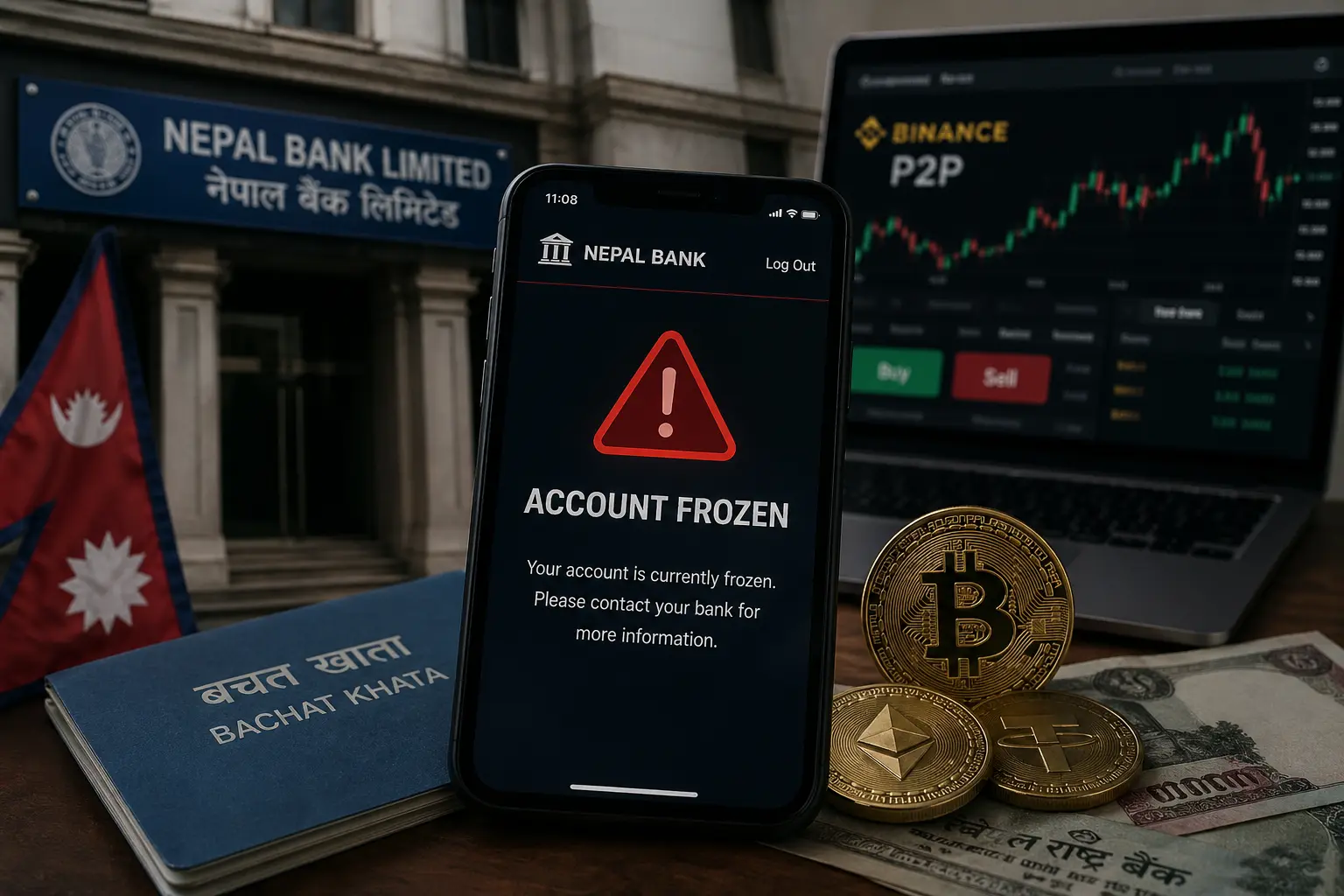
Introduction: The Reality Most People Hear About, But Don’t Understand
If you’re even slightly involved in crypto in Nepal, you’ve probably heard warnings like “bank account freeze huncha”. It’s everywhere—friends, Telegram groups, even random comments. But the strange part is, almost no one actually explains how it happens.
Most people assume that bank accounts only get frozen if someone is doing something serious or illegal. But the ground reality in Nepal in 2026 feels very different. Accounts are getting restricted or frozen even for people who just tried P2P once, freelancers receiving payments, or beginners testing crypto for the first time.
The problem isn’t always what you did. Sometimes it’s about who you transacted with, or how your transaction looks from the bank’s perspective. That’s what makes this situation confusing and risky at the same time.
This article isn’t based on theory or assumptions. It’s based on real patterns happening across Nepal—cases that are becoming more common as crypto usage grows despite restrictions.
Why Crypto Transactions Look Suspicious to Nepali Banks
The root of the issue starts with one simple fact—crypto is still not recognized by the financial system in Nepal. Because of that, banks don’t see crypto transactions as normal digital activity. Instead, they often appear as random money transfers between unknown individuals.
When you do a P2P trade, from your side it’s simple: you send or receive money and get crypto in return. But from the bank’s side, there’s no visible connection to crypto. All they see is money moving between accounts with no clear explanation.
If this happens occasionally, it might go unnoticed. But when patterns start forming—multiple transactions, different senders, irregular amounts—it begins to look unusual. And in Nepal’s banking system, unusual often means suspicious.
This is where many users unintentionally step into risk without realizing it.
The Hidden Chain Behind Every Transaction
One of the biggest misunderstandings people have is thinking that only their transaction matters. In reality, what matters more is the entire chain connected to that transaction.
Imagine you sell USDT through P2P and receive money from someone. You don’t know that person personally. You just trust the platform and complete the deal. Everything feels normal.
But what if the money that person sent you came from another account involved in fraud? Or maybe that person is using a compromised bank account? Suddenly, your account becomes part of a larger chain.
If a complaint is filed anywhere in that chain, the investigation doesn’t stop at the original account. It moves through every connected transaction. That’s how completely unaware users end up getting flagged.
This is something many people don’t realize until it actually happens to them.
How Bank Freezing Actually Happens in Nepal
The process usually doesn’t feel dramatic in the beginning. There’s no immediate warning or clear signal. It often starts quietly.
You might be using P2P regularly, similar to what’s explained in “Binance P2P in Nepal: Safe or Dangerous?”, and everything seems fine. Transactions go through, money arrives, crypto is exchanged.
Then one day, a complaint is filed somewhere in the transaction chain. It could be a fraud case, a hacked account, or even a dispute unrelated to you. Once that happens, authorities begin tracing the movement of money.
When your account appears in that flow, it gets flagged. At this point, the bank doesn’t analyze your intention. It simply reacts to the risk signal.
That’s when restrictions begin. Sometimes it’s partial—like limited transactions. Other times, the account gets fully frozen without detailed explanation. For the user, it feels sudden. But in reality, it’s the result of a chain reaction that started somewhere else.
Real Situations Happening Across Nepal
In 2026, this isn’t rare anymore. It’s happening in different forms, across different types of users.
A student might try crypto out of curiosity, complete one or two P2P transactions, and move on. Days later, their account stops working. They have no idea what went wrong because from their side, everything was simple and small.
A freelancer might receive payments in crypto and convert them through P2P regularly. Over time, the pattern of incoming funds from different sources starts to look unusual to the bank. Eventually, the account gets flagged, even though the income was genuine.
Even users who deal repeatedly with the same “trusted seller” aren’t completely safe. If that seller gets involved in suspicious activity later, every connected account—including yours—can come under scrutiny.
This connects closely with the risks discussed in “How Nepali Freelancers Receive Crypto Payments in 2026”, but here you’re seeing the consequences, not just the method.
Why Innocent Users Still Get Affected
One of the hardest parts to accept is that innocence doesn’t always protect you in this situation.
The system doesn’t work based on intent. It works based on transaction patterns and connections. If your account is part of a suspicious chain, it gets treated as part of the case, regardless of your awareness.
There’s also a lack of clarity in how these situations are handled. Users often don’t get detailed explanations. They’re just told their account is under review or temporarily restricted.
This creates confusion and fear, especially for people who were just exploring crypto or trying to earn online.
What It Feels Like When Your Account Gets Frozen
The moment your account stops working, everything changes.
At first, it might just be a failed transaction or a delay. Then you try again, and nothing happens. Eventually, you realize something is wrong. Mobile banking may stop responding properly. Withdrawals don’t go through.
The real pressure starts when you think about the money inside the account. For many users, that money isn’t extra—it’s savings, income, or daily expenses.
On top of that, there’s fear. Questions start coming in—Is this a legal issue? Will there be consequences? Should I be worried about something bigger?
This is where the situation becomes more than just financial. It becomes psychological.
The Emotional Side No One Talks About
Most content around crypto focuses on profits, strategies, or risks in terms of money. But situations like this hit differently.
There’s panic in the beginning, followed by confusion. Then comes stress, especially if you have to explain it to family members who may not even understand what crypto is.
For younger users, especially students, it can feel overwhelming. A simple experiment turns into something serious, and they’re not prepared for it.
This emotional pressure is something people only understand after experiencing it.
The Role of Telegram Groups and Informal Networks
Another layer to this issue is how people connect and trade.
Many users enter crypto through Telegram groups, referrals, or informal contacts. These spaces often promote quick trades, easy profits, and “trusted sellers.” But they also increase exposure to unknown people.
This connects directly with “How Telegram Crypto Groups Scam Nepali Users”, because the same environment that enables scams also increases the risk of problematic transactions.
When deals happen outside structured platforms, there’s even less protection. And once money moves, there’s no control over where it came from or what it’s linked to.
A Simple Breakdown of Risk Factors
Even though the system is complex, some patterns consistently increase risk. Here’s a clear view:
| Situation | What the Bank Sees |
|---|---|
| Frequent P2P transactions | Trading-like behavior |
| Multiple unknown senders | Unverified income source |
| Sudden large deposits | Unusual activity |
| Linked fraudulent transactions | Risk involvement |
| Irregular transaction timing | Suspicious pattern |
These don’t guarantee a freeze, but they increase the chances.
What Happens After the Freeze
Once your account is frozen or restricted, the process of resolving it is not always quick.
You may need to visit your bank physically and explain your transactions. Sometimes the bank itself may not have full control, especially if the issue is linked to a broader investigation.
In certain cases, authorities may get involved, which increases the seriousness of the situation. Even if things eventually get resolved, the time and stress involved can be significant.
This connects with the concerns raised in “Can You Go to Jail for Using Crypto in Nepal?”, because for many users, the fear becomes real during this stage.
The Bigger Reality in 2026
Crypto usage in Nepal is growing, even with restrictions in place. More people are exploring it for freelancing, trading, or curiosity. But with that growth comes increased risk.
Banks are becoming more cautious. Systems are becoming stricter. And transaction monitoring is improving.
This means that situations like account freezes are not decreasing—they are becoming more common.
At the same time, awareness is still low. Many users enter crypto without understanding these backend risks.
Final Thoughts: A Reality You Can’t Ignore
Crypto in Nepal is not just about opportunities. It’s also about navigating a system that doesn’t fully support it.
Bank account freezing is one of the clearest examples of that gap. It shows how something that feels simple on the surface can become complicated due to underlying systems and regulations.
The most important thing to understand is that risk doesn’t always come from your actions alone. Sometimes it comes from the environment you’re operating in.
And in Nepal’s current situation, that environment is still uncertain.